
Dialing Sanford Phone Codes
Local calling in Sanford uses the full ten-digit number. That means the area prefix at the front of a local number is not optional: dial the area code and the seven-digit number for local Sanford calls. The rule comes from the 919/984 overlay. When two area codes share the same geography, the network needs all ten digits to know whether a caller means a 919 number or a 984 number. The North Carolina Utilities Commission report on the overlay says 984 was planned for the same boundaries as 919, while existing 919 customers kept their numbers.
Short service codes still stay short. Emergency, crisis, relay, utility-location, carrier-service, and community-resource codes do not become ten-digit numbers just because Sanford uses overlay dialing. The daily split is simple: person or office numbers need the full local number, while N11 shortcuts route through special service systems. Some carriers may still ask for 1 before certain toll or long-distance calls, but Sanford directory instructions should begin with area code plus number.
- For a local Sanford number, dial the area code and seven-digit number.
- For domestic long distance, dial 1 if the carrier or phone system requires it, then the ten-digit number.
- For toll-free calls, dial 1, then the toll-free prefix and seven-digit number.
- For international landline calls, dial 011, then the country code and destination number.
- For N11 service shortcuts, dial the three-digit code by itself.
Note: Sanford had ten-digit local dialing before the national 988 rollout, so that change did not create a new local dialing rule.
Sanford N11 Service Codes
N11 codes are short service codes assigned for public, carrier, or community use. Sanford residents can use some of them the same way callers do across North Carolina, but one local detail matters: no official City of Sanford 311 service was located in the city sources reviewed. For city questions, use the City of Sanford staff directory, the relevant department number, Public Works, Customer Service, police non-emergency, or city and county online forms instead of assuming 311 exists.
Community help is different. United Way of Lee County's NC 211 page states that Lee County has a local 2-1-1 call center and resource database, while statewide NC 211 is available all day for health and human services referrals. Safety codes are more direct: emergency calls go to 911, and the crisis line is reached through 988. Short codes should be used for the service they name, not as a shortcut to every local office.
| N11 code | What it reaches in Sanford context |
|---|---|
| 211 | NC 211 and United Way referrals for food, housing, utility help, health care, and social services. |
| 311 | No official Sanford 311 service located; use city department numbers and online forms. |
| 411 | Carrier directory assistance, often less useful than official city, county, school, or hospital directories. |
| 511 | Traffic and travel information where provided by North Carolina transportation systems. |
| 611 | Phone carrier repair or customer service from many lines. |
| 711 | Telecommunications Relay Service for TTY and relay users. |
| 811 | Call Before You Dig utility-location request before excavation. |
| 911 | Emergency police, fire, and medical response. |
| 988 | Suicide and Crisis Lifeline, active nationwide since July 16, 2022. |
Sanford Star Codes
Vertical service codes are the star codes that turn call features on or off from a phone line. They are not Sanford government numbers. They are carrier features. A Sanford landline, wireless line, or VoIP account may support a different mix of star features, and some features may have fees or app-based replacements. The codes below are the common reference set from the research, with carrier support as the key caution.
| Star code | Common function | Sanford calling note |
|---|---|---|
| *57 | Call trace | Often used after threatening or harassing calls; contact the carrier or law enforcement for follow-up. |
| *60 | Selective call block | Blocks selected numbers where the carrier supports it. |
| *67 | Block caller ID | Dial before one outgoing call; do not use it for emergency calls. |
| *69 | Last-call return | Support and fees vary by provider. |
| *70 | Disable call waiting | Used for one long call, fax, modem, or uninterrupted connection. |
| *72 | Activate call forwarding | Carrier-specific steps can differ. |
| *73 | Cancel call forwarding | Usually paired with the forwarding activation feature. |
| *77 | Anonymous call rejection | May not block spoofed caller ID. |
| *82 | Unblock caller ID | Used for one outgoing call when a line blocks caller ID by default. |
For harassment, fraud, or threats, a star code is only one part of the response. Save the date, time, displayed caller ID, voicemail, and text content before calling Sanford Police non-emergency or the Lee County Sheriff's Office through their official directories.
Sanford Calling Code Formats
Area codes are one class of phone code. Sanford is in the 919/984 overlay complex, so a local number can begin with either 919 or 984 and still be tied to the same broad Triangle-centered numbering region. The older code is 919, which appears throughout Sanford public numbers. The overlay code is 984, which is a newer pool for the same geography, not a separate part of the city. The geographic detail behind those codes belongs with Sanford phone area codes; here the practical issue is how the calling prefix is dialed.
- 919 is the familiar Sanford and Lee County calling code, created from 704 in 1954.
- 984 is the overlay calling code sharing the same geography as 919, with assignments available starting April 30, 2012.
- 704 is historical context only for Sanford, because it was North Carolina's original statewide code before 919 was created.
The NCUC telecom report is useful because it explains why an overlay keeps existing numbers in place while adding a new code. That is why a 984 number can be local to Sanford even when most public offices still publish 919 numbers.
Toll-Free and Premium Codes
Toll-free prefixes are service prefixes, not location codes. A Sanford resident may call an 800, 888, 877, 866, 855, 844, or 833 number for a bank, insurer, carrier, hospital billing office, utility vendor, or state agency, yet the prefix itself does not identify a Sanford office. Toll-free numbers are assigned and reassigned nationally. Treat them as service numbers, not geographic proof.
- 800, 888, 877, 866, 855, 844, and 833 are toll-free NANP prefixes, not Sanford geography markers.
- 900 is associated with premium-rate services, so billing controls and carrier blocks matter.
- 976 is a legacy local premium or information-service code that may be obsolete or blocked.
Unwanted sales calls that use toll-free or local-looking prefixes can be reported through the FTC Do Not Call Registry. The registry does not stop spoofed scam calls on its own, but complaint data supports enforcement and can help separate legal sales calls from abusive patterns.
The Do Not Call landing page captured for Sanford dialing research shows the consumer-facing complaint and registration path.
Use that official channel for telemarketing complaints, then use local police or sheriff contacts when threats, theft, or active fraud are involved.
International Codes from Sanford
Sanford numbers follow the North American Numbering Plan. The country code is +1 for the United States, Canada, and other NANP territories. The safest contact format for mobile phones is +1 followed by the ten-digit number, because it works locally and while traveling. A local Sanford contact saved only as seven digits is more likely to fail or become ambiguous.
- To call another Sanford number, dial the area code and seven-digit number.
- To save a Sanford mobile contact, use +1, then the full ten-digit number.
- From a Sanford landline calling abroad, dial 011, then the destination country code, then the local number.
- From a mobile phone calling abroad, use +, then the country code, then the local number.
- From another country calling Sanford, dial that country's exit code, then 1, then the ten-digit Sanford number.
Sanford NXX Prefix Codes
The NXX is the three-digit code after the area code. In a number written as NPA-NXX-XXXX, NPA means the area code, NXX means the central office or exchange prefix, and XXXX is the line number. Sanford's public directories show a strong local pattern: 919-774 appears in Lee County Schools and Central Carolina Hospital numbers, 919-775 appears in police, fire, and customer service numbers, 919-777 appears in city administration and engineering, and 919-718 appears often in county and joint development functions.
Technical prefix tools are useful, but they are clues, not identity proof. The TelcoData Sanford rate-center lookup shows NPA-NXX rows, carrier names, CLLI, LATA, and prefix type for SANFORD. The Local Calling Guide Sanford exchange page lists related Sanford prefixes under the local rate-center context. Number portability can move a number from one carrier to another, and spoofing can display a local-looking prefix on a call that did not come from Sanford.
The TelcoData screenshot below is tied to the Sanford rate-center lookup rather than a personal search.
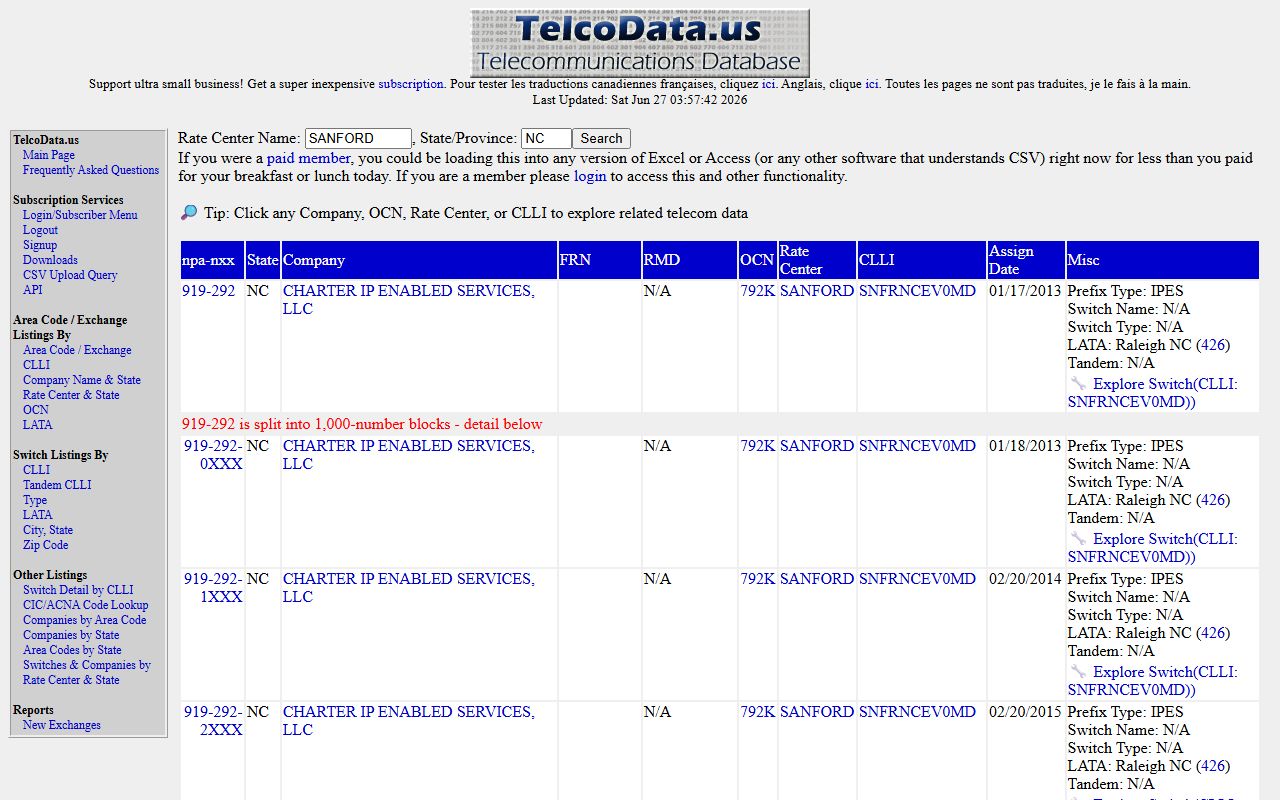
Use NXX data to understand the original rate center or likely line type, then verify important calls through official directories.
| Prefix group | Sanford clue | Limit |
|---|---|---|
| 919-774 | Schools, hospital, and older civic institutions. | Porting can change the current carrier. |
| 919-775 | Police, fire, customer service, and city emergency routing. | Caller ID can be spoofed. |
| 919-776 | Transit, library, and older Lee County resources. | Not every 776 call is a public office. |
| 919-777 | City administration, engineering, and staff direct lines. | Still verify through the city directory. |
| 919-718 | Lee County and joint city-county development functions. | Use official county pages for current numbers. |
| 984 blocks | Valid Sanford overlay numbers such as 984-270 examples. | Newer overlay codes do not prove a specific caller. |
Sanford Spam Code Labels
Caller ID labels such as "Likely Spam" or "Spam Risk" are not dialing codes, but they are code-like labels that carriers attach to calls. The FCC call authentication reference explains STIR/SHAKEN, the framework carriers use to help verify that caller ID is authorized by the originating provider. Authentication is not the same as safety. It can help detect spoofing, but it does not tell a Sanford resident whether a caller's story is true.
Local-looking 919 or 984 caller ID can still be spoofed. For a call claiming to be from Sanford Police, TriRiver Water, Lee County DSS, a court office, a school, or Central Carolina Hospital, hang up and call the number from the official directory. For unwanted calls, spoofing, robocalls, billing disputes, or accessibility complaints, use the FCC Consumer Complaint Center, the FTC Do Not Call Registry, NC DOJ Consumer Protection, or NCUC channels when the issue involves regulated telephone service.
The FCC Reassigned Numbers Database is another official numbering tool, mainly for businesses checking whether a number may have changed subscribers.
That database is not a consumer people-search site, but it helps explain why old contact lists and automated callers can reach the wrong person.
Sanford Phone Code Definitions
Numbering terms can sound more technical than they are. These definitions keep Sanford dialing formats, exchange clues, and carrier labels separate.
- NPA
- Numbering Plan Area, the three-digit area code at the start of a North American number.
- NXX
- Central office or exchange code, the three digits after the area code.
- N11
- A three-digit service code such as 211, 711, 811, 911, or 988.
- Vertical service code
- A star code that triggers a calling feature on a carrier line.
- Toll-free prefix
- A non-geographic NANP prefix such as 800, 888, 877, 866, 855, 844, or 833.
- NANP
- The North American Numbering Plan, the +1 country-code system that includes the United States.
Look Up Sanford Phone Codes
Use the code type to choose the lookup path. For local dialing rules, rely on area-code and regulator references. For NXX prefix context, use rate-center tools, then verify any official caller through the city, county, court, school, utility, or hospital directory. For spam labels, use federal and state complaint channels rather than treating a prefix as proof of identity.
Note: A Sanford prefix can narrow the question, but the current office, person, carrier, or caller intent still needs direct verification.